The Sydney Rewilding Initiative team has been hard at work monitoring our reintroduced population of boguls (Dharug), also known as the native bush rat (Rattus fuscipes), and preparing for future translocations. We have also been working to supress the number of invasive black rats (Rattus rattus) in reserves so that our boguls can thrive. How do we know which rat is which?
Boguls/bush rats (Rattus fuscipes)
Boguls are small, shy, native Australian rodents. Their main features are their:
- Rounded face (sometimes referred to as a ‘roman nose’)
- Short, thin tail, which is roughly the same length as their body
- Grey- to reddish-brown fur
- Generally ‘cute’ appearance
They live in dense, structurally complex vegetation in forests, woodlands and heath, avoiding open or urban areas where invasive black rats thrive. Unlike black rats, bush rats are strictly terrestrial, ground-dwelling rodents that nest in short burrows under logs, rocks or grass trees, sometimes sharing burrows with other individuals – they are known to be quite a social species, just like us!
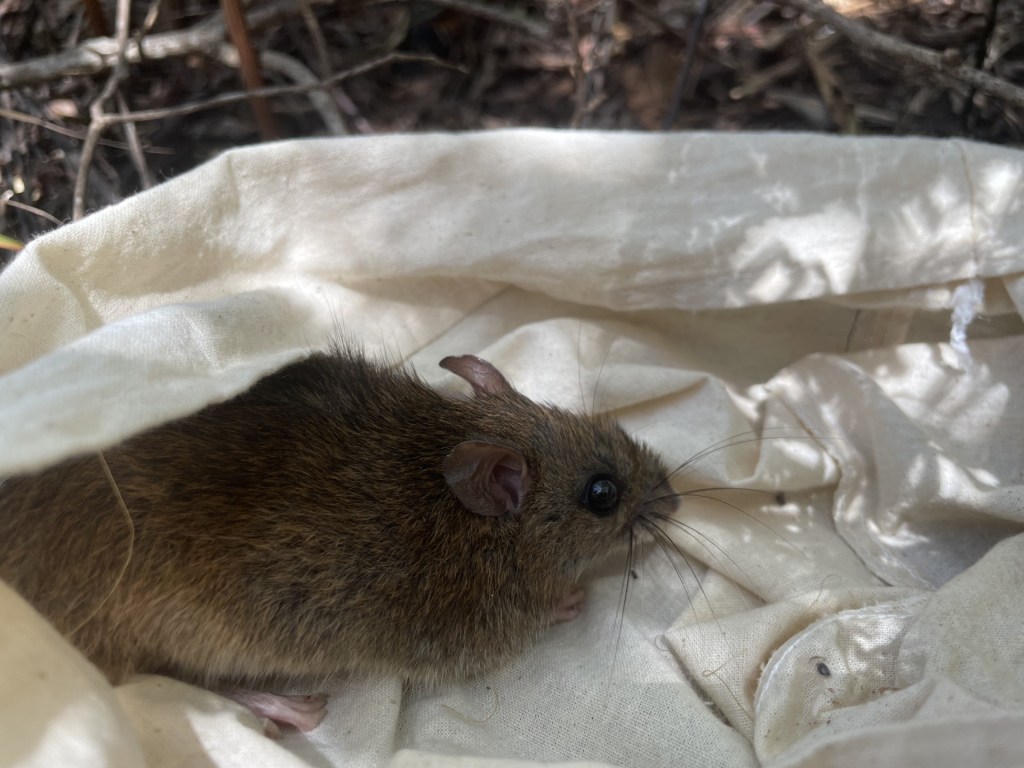
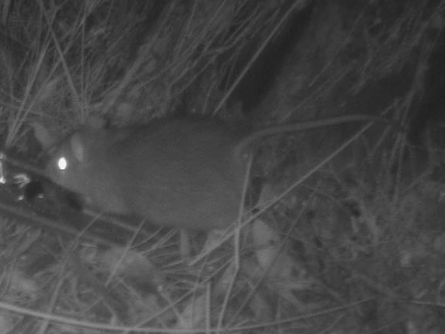
They play a positive ecological role by eating fungi, seeds, insects and plant material, and are known native pollinators—able to access flowers on fine stems that heavier black rats cannot. Health studies show bush rats have normal blood values and only carry wildlife-specific parasites that pose no risk to people or pets. During past translocations of bush rats there were no parasites or microbes of concern detected in blood samples taken by researchers. Importantly, bush rats do not prey on native vertebrates. Instead, they have been shown to suppress black rat populations through direct interference competition, providing valuable biological resistance that helps protect native habitats from invasive rodent impacts.
Black rats (Rattus rattus)
Black rats are larger, invasive rodents and their main features are their:
- Pointed face, with large ears,
- Slender body
- Very long tail that extends well beyond their head–body length
Unlike bush rats, they thrive in urban, agricultural and coastal environments and readily move between houses, urban areas and nearby bushland. They are highly adaptable and often arboreal, actively climbing trees and nesting in roofs, ceilings and vegetation. Black rats are generalist omnivores that eat a wide range of foods—including vegetation, fungi, invertebrates, seeds, and importantly, small vertebrates, bird eggs and young—giving them far greater predatory impacts than native bush rats.
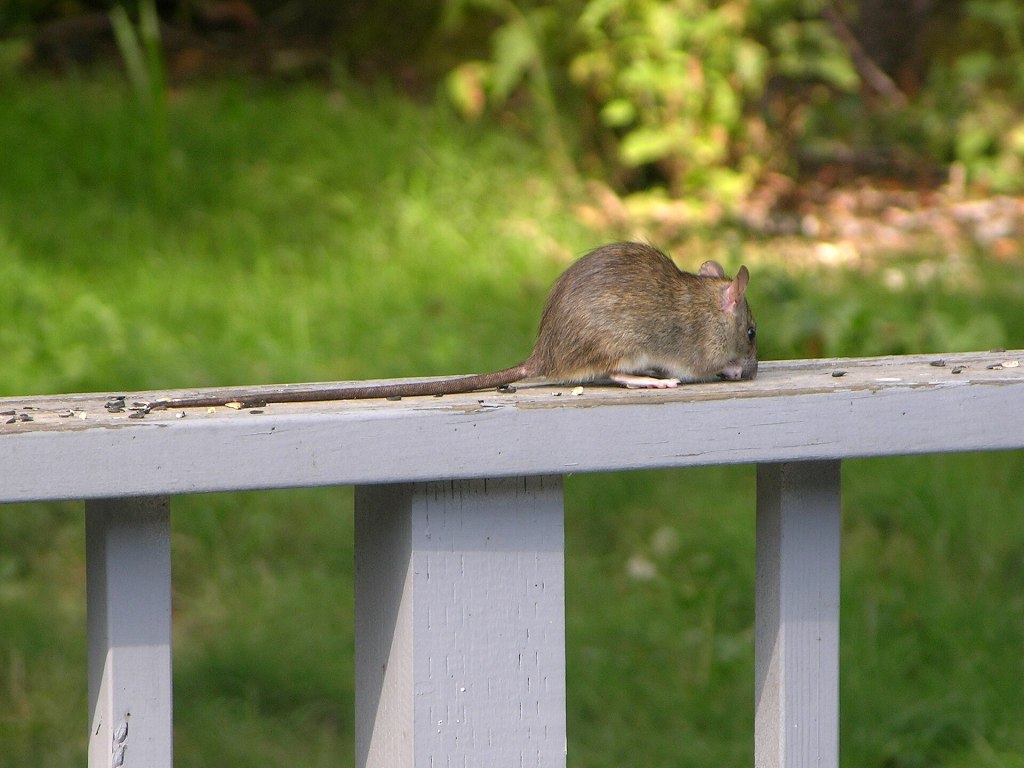
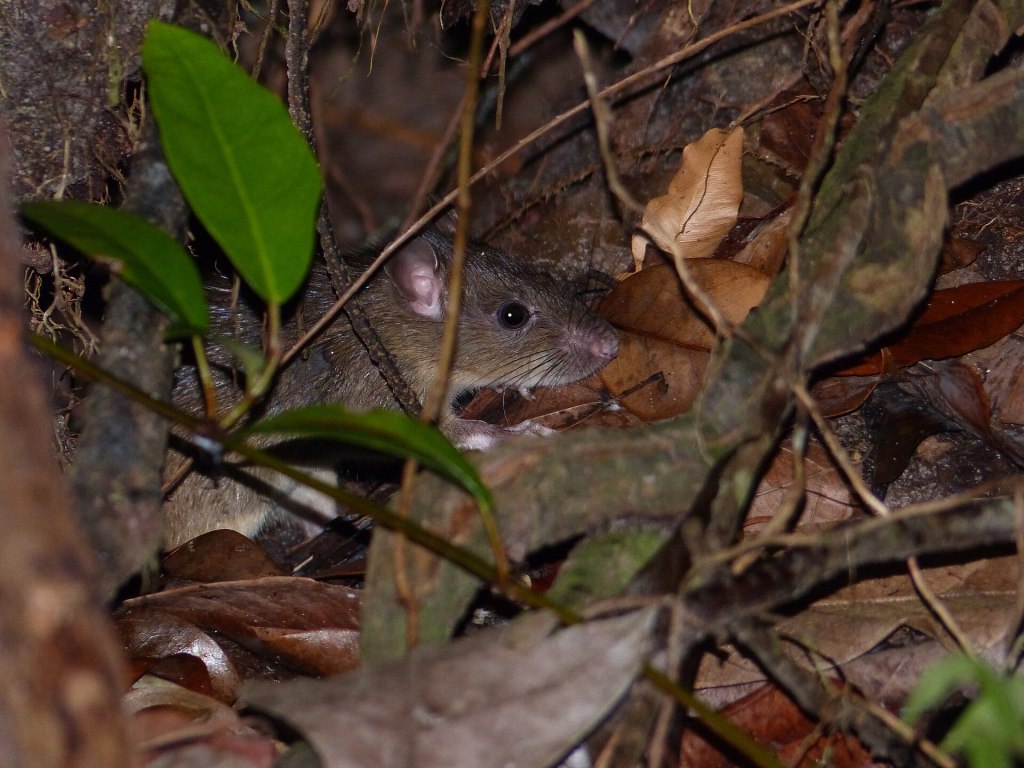
They also host a wider range of parasites and pathogens that can affect people, wildlife and domestic animals. Ecologically, black rats cause multiple negative impacts: they directly predate native fauna, consume large volumes of seeds (reducing native plant regeneration), and support invasive predators like foxes and cats by acting as an abundant food source, a process known as hyperpredation. These traits contrast sharply with bush rats, which do not prey on native vertebrates, do not boost predator populations, and play a balanced native role in ecosystems.
What if I can’t identify a rat?
If you are unsure about what species a rat is, the Australian Museum has a team of experts who can help with species ID. You can contact them here.
More scientific information can be found at:
Banks PB, Hughes NK (2012) A review of the evidence for potential impacts of black rats (Rattus rattus) on wildlife and humans in Australia. Wildlife Research 39, 78. doi:10.1071/WR11086
Banks PB, Smith HM (2015) The ecological impacts of commensal species: black rats, Rattus rattus, at the urban–bushland interface. Wildlife Research 42, 86. doi:10.1071/WR15048
Ellis AB, Hochuli D F, Banks PB (2025) Potential impacts of black rats (Rattus rattus) on seeds and seedlings of woody species in a regenerating island rainforest plant community. Austral Ecology. doi:10.1111/aec.70109
McDonogh TL, Thompson PP, Sangster CR, Meagher PJB, Vogelnest L (2015) Hematologic and biochemical reference values of the Australian bush rat (Rattus fuscipes). Journal of Wildlife Diseases 51, 795–799. doi:10.7589/2014-08-201
O’Rourke RL, Anson JR, Saul AM, Banks PB (2020) Limits to alien black rats (Rattus rattus) acting as equivalent pollinators to extinct native small mammals: the influence of stem width on mammal activity at native Banksia ericifolia inflorescences. Biological Invasions 22, 329–338. doi:10.1007/s10530-019-02090-x
Saul AM (2013) Aliens replacing natives: are black rats effective substitutes for extinct native mammalian pollinators? [Honours thesis] The University of Sydney
Smith HM, Dickman CR, Banks PB (2016) Nest predation by commensal rodents in urban bushland remnants. PLOS ONE 11, e0156180. doi:10.1371/journal.pone.0156180
Stokes VL, Banks PB, Pech RP, Spratt DM (2009) Competition in an invaded rodent community reveals black rats as a threat to native bush rats in littoral rainforest of south-eastern Australia. Journal of Applied Ecology 46, 1239–1247. doi:10.1111/j.1365-2664.2009.01735.x
St Clair JJH (2011) The impacts of invasive rodents on island invertebrates. Biological Conservation 144, 68–81. doi:10.1016/j.biocon.2010.10.006
Extended photo credits:
- ‘Long-tailed black rat (Rattus rattus)‘ by Alex O’Neal is licensed under CC BY-SA 2.0 ↩︎
- Black Rat (Rattus rattus) under the Tree House (15858296885)‘ by Bernard Dupont is licensed under CC BY-SA 2.0 ↩︎


Leave a comment